In the 2026 professional landscape, the “open office” experiment has officially failed the privacy requirements for modern legal, medical, and financial tenants. If you can hear a coworker’s Zoom call word-for-word through a wall, you don’t have a “noise problem,” you have an engineering deficiency.
Most Canadian commercial spaces were never built for true acoustic isolation. Between glass, heavy aesthetic and lightweight partition bills most offices operate at an effective STC (Sound Transmission Class) of 30 or less, or normal speech is clearly audible between rooms.
The good news? Some privacy can be fixed–if you stop looking at decor and start looking at the science of isolation.
The Hidden Reason Offices Sound So Loud: Modern Design Trends
Today’s offices in the GTHA (Greater Toronto and Hamilton area) and Calgary Metropolitan area look great, but acoustically, they are a nightmare for three specific reasons:
- Interstitial Plenum gaps (The slab-to-deck failure)
- In most Toronto high-rises and Calgary “Plus 15” buildings, the wall stops at the drop ceiling, leaving a massive open cavity (the plenum) between the wall and the structural concrete slab above.
- The technical reality: An unsealed plenum creates a “flanking path” that can drop your effective assembly performance by 25+ STC points, rendering even “premium” walls useless for confidential conversations.
- Result: Voices travel freely between offices, meeting rooms, and even different tenants.
- The technical reality: An unsealed plenum creates a “flanking path” that can drop your effective assembly performance by 25+ STC points, rendering even “premium” walls useless for confidential conversations.
- In most Toronto high-rises and Calgary “Plus 15” buildings, the wall stops at the drop ceiling, leaving a massive open cavity (the plenum) between the wall and the structural concrete slab above.
- HVAC and mechanical flanking paths
- Modern LEED-certified buildings often use Variable Air Volume (VAV) systems that inadvertently act as “speaking tubes” between private offices. Without internal lining or sound, attenuators, these metal ducks carry high frequency speech from one office directly into the next.
- Sound energy is like water and it will find the path of least resistance and loves to travel:
- Ductwork
- Vents
- Return air pathways
- Bulkheads
- A private office with an open duct is about as private as a whisper in a hallway.
- Sound energy is like water and it will find the path of least resistance and loves to travel:
- Modern LEED-certified buildings often use Variable Air Volume (VAV) systems that inadvertently act as “speaking tubes” between private offices. Without internal lining or sound, attenuators, these metal ducks carry high frequency speech from one office directly into the next.
- Lightweight “code-minimum” partitions
- Many GC’s build to the absolute minimum: 3 ⅝” steel studs and single layer ½” drywall with zero insulation. This isn’t a wall; it’s a sound carrier. Worse yet, they might claim to have added sound-isolating walls by simply upgrading to ⅝” drywall with the low-to-average acoustic-rated insulation, and call it a day for soundproofing.
The real cost of acoustic failure: liability, compliance, and turnover
In the Toronto and Calgary, commercial markets, “poor acoustics” is often dismissed as a comfort issue. However, for firms operating in the legal, medical, and financial sectors, acoustic failure is a measurable business liability that extends far beyond simple distraction.
Here’s is the technical reality of what speech leakage cost a Canadian business:
- Regulatory & Legal Non-Compliance: For medical clinics in Alberta and Ontario, the Health Information Act (HIA), Personal Information Protection Act (PIPA), and PIPEDA mandate patient confidentiality. If a consultation is audible in a waiting room due to a “code-minimum” wall assembly, the clinic is in active breach of privacy regulations.
- The “Class A” Tenant Trap: In the Toronto Financial District, premium lease agreements often specify Noise Criterion (NC) levels of 30 or lower. Failure to meet the specs isn’t just a nuisance; it’s a breach of the Tenant Improvement (TI) agreement that can lead to lease disputes and expensive post-occupancy remediation.
- Cognitive Fatigue & Error Rates: while generic productivity stats are common, the engineering reality is Cognitive Load. Research in psychoacoustics show that “intelligible background speech” (hearing exactly what a coworker is saying) is significantly more disruptive than random noise. In high-stakes environments like law firms or trading floors, this leads to an increase in manual errors and reduced “Deep Work” output.
- Diminished Asset Value: For property owners in Calgary’s Beltline or downtown Toronto, “loud” suites are harder to lease and have higher turnover rates. In an era where “Quiet Luxury” is the expected standard for high-end professional suites, poor acoustics represent a permanent discount on the property’s valuation.
The Real Reason DIY “Fixes” Don’t Work (And why they’re a Liability)
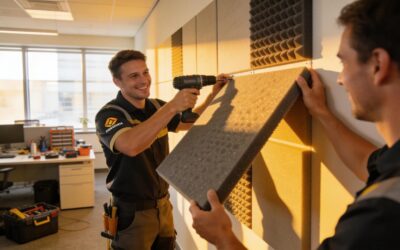
in the Toronto and Calgary, commercial markets, “DIY” isn’t just ineffective, it’s a compliance risk. Many attempt to solve privacy issues using foam panels or rugs. These are absorption treatments designed to reduce echo inside a room; they have near zero impact on sound isolation (stopping sound from leaving the room).
More importantly, generic “acoustic foam panel” often fails to meet the stringent CAN/ULC fire safety standards required by Ontario and Alberta building codes.
| Treatment | Acoustic Function | Fire Safety & Compliance |
| Acoustic Foam/Panels | Absorption (Echo reduction only) | Often fails CAN/ULC-S102; creates toxic smoke. |
| Thick Carpeting/Rugs | Impact Noise (IIC) only | Minimal impact on Speech Privacy (STC). |
| Inaudible Dense-Pack | Isolation (Mass + Seal) | Fully compliant with CAN/ULC-S703; smoulder-resistant. |
How Inaudible Fixes Office Sound Privacy at the Source
At Inaudible, we address the root causes of sound transfer. Our commercial solutions are engineered around real acoustic principles: Sound Transmission Class (STC), Impact Insulation Class (IIC), leaking/flanking paths, and material density. We aim to meet or exceed National Building Code of Canada (NBC) standards for speech privacy.
1. Dense-Pack Cellulose Retrofits (OBC/ABC Compliant)
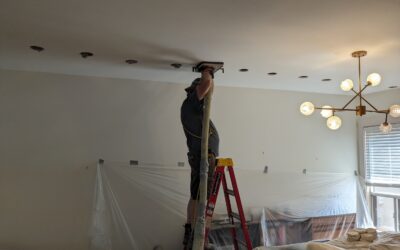
We inject a high-velocity, dense cellulose fiber pack directly into existing wall cavities, when walls lack insulation for dense mass.
- The Advantage: this creates a monolithic mass layer that eliminates the “hollow drum” effect without removing a single sheet of drywall.
- Compliance: our cellulose fibre insulation CAN/ULC-S703 standards, making it the gold standard for high-rise offices in the Toronto Financial District or Calgary’s Beltline.
2. Slab-to-deck transition & Plenum sealing
We install engineered plenum barriers and acoustic bulkhead that bridge the gap from the top of the partition to the structural deck. This stops sound from bypassing the wall, restoring the rooms effective STC rating from the failing 25 to a confident 50+.
3. Mechanical and VAV flanking mitigation
We identify and treat mechanical paths using CAN/ULC-S102 compliant internal linings and cross talk attenuators (silencers). This ensures air moves freely while speech energy is trapped before it enters the next room.
Quiet is a business asset, not a luxury
Acoustic leakage isn’t just annoying; it’s a liability for PIPEDA-compliant medical clinics and FINTRAC-regulated financial firms. You can’t fix acoustics with the decor. You fix them with science.
Ready for a Quieter, More Productive Office?
Inaudible specializes in engineering real sound isolation for Canadian businesses.
- Fast Retrofits | No Major Demolition Options | Proven Results
Select Your Region for a Free 15-Minute Consultation:
Serving the Greater Toronto & Hamilton Area and the Calgary Metropolitan Region.