The Truth About Soundproof Spray Foam in Calgary (And What to Use Instead)
If you live in Calgary, you probably heard of spray foam. When it comes to blocking out the cold temperature of winters and keeping your home thermally efficient, it is an absolute powerhouse.
Because it works so well for temperature control and sound sealing, it’s no surprise that soundproof spray foam in Calgary is one of the most searched terms by homeowners looking to quiet down their houses.
But let’s be completely candid: While spray foam is a good thermal insulation, it ranked at the bottom for soundproofing. The 1/2 pound is a little better but the highly praised 2LB closed-cell could not be worse (no insulation does worse period).
Whether you are trying to silence a home theater, block out a noisy street, or tackle a Calgary basement suite soundproofing, relying solely on spray foam might waste your money.
Here is why—and what top acoustic professionals use instead.
The Spray Foam Misconception
When homeowners search for acoustic insulation installation in Calgary, they usually stumble into the debate of open cell vs closed cell foam for soundproofing.
Neither insulations was designed for sound reduction.
Here is the reality of both:
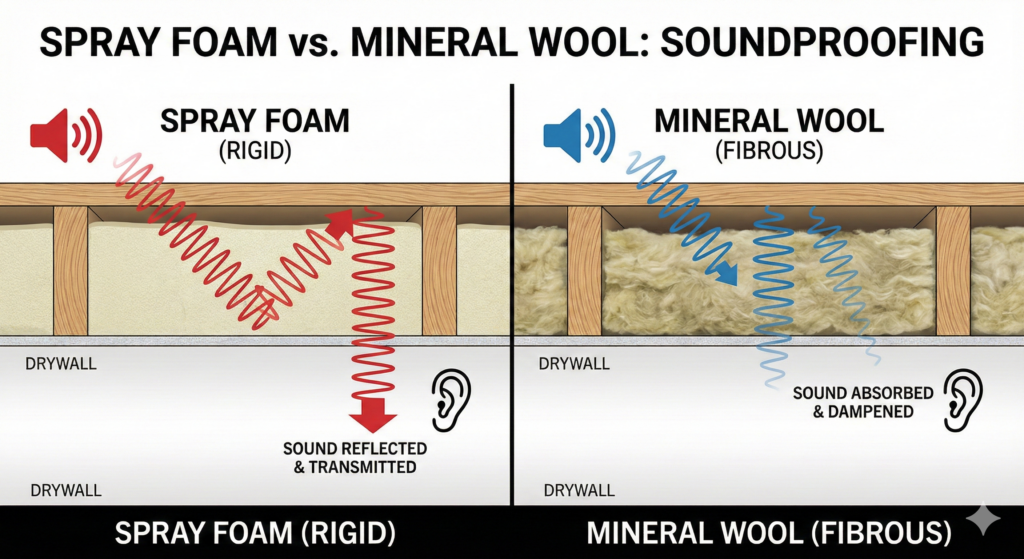
- Closed-Cell Foam: This is the dense, rigid foam that is incredible for thermal resistance and vapor barriers. However, because it cures into a hard, stiff solid it actually amplifies the noise and vibrations.
- Open-Cell Foam: This foam is lighter and more porous. It does absorb some sound, making it slightly better than closed-cell for acoustics. However, its low mass means it struggles to block low-frequency noises like heavy footsteps, bass from music, or the rumble of a furnace.
Look at this link https://www.sprayfoammagazine.com/foam-news/foam-sound/3230
If you are looking for the best insulation for soundproofing a basement ceiling in Calgary, you need a material engineered specifically for acoustic absorption.
Real life stories from homeowners
First, I want to say that at Inaudible, we are not fans of any strong chemical insulation like poly-urethane spray foam. And for many reasons (read our other blog post about it)
Alright, I could tell you a bunch of facts and then wait for some spray foam company to come and rebut.
But, instead, I will share 2 stories from real people who called us with some “BAD” noise issues in the Calgary area.
1: The first one was a woman who had just moved in her brand new custom build house expecting serenity (she was a light sleeper). But then, she quickly realized that she could hear people talking outside, the wind blowing, the leaves scratching the siding, the rain and a bunch more. First she called the contractor who could not really answer the question. After all, he had built her a beautiful home with “all the best materials”. So after some time she called us.
My first question to her was “Do you have spray foam in your walls”. She said “yes, the entire house is insulated with that”. From there my options to her were sort of limited, I knew she wouldn’t like any of them. So I said “here are the options” :
1: We re-insulate the entire house by either drilling holes and pumping the insulation inside the cavities (Dense-fill no drywall removal)
2: You call another company to remove the drywall completely and the foam completely, I hope for you they won’t damage any wires.
3: We add layers of comfort board 80 insulation and re-drywall
None of the options were close to affordable.
We did a follow-up a few months later and she had sold the house. Her dream house.
2: The second one was a man who wanted to muffle the noise of footsteps in his man cave from his children. He had looked at 20 videos about spray foam 2LB and how hard it is. We had many conversations about it but, despite he was still convinced that it was the way to go.
So he called a spray company to spray the ceiling in the basement. About half way in he told them to stop. Paid them $2000 for the trouble and then called us. I answered and he said that the 2LB foam had made the problem worse.
From there we scheduled him for our products. A week later we had a happy customer who had wasted $2000 on a service that was never designed for sound reduction.
The Superior Alternative: Rockwool Mineral Wool
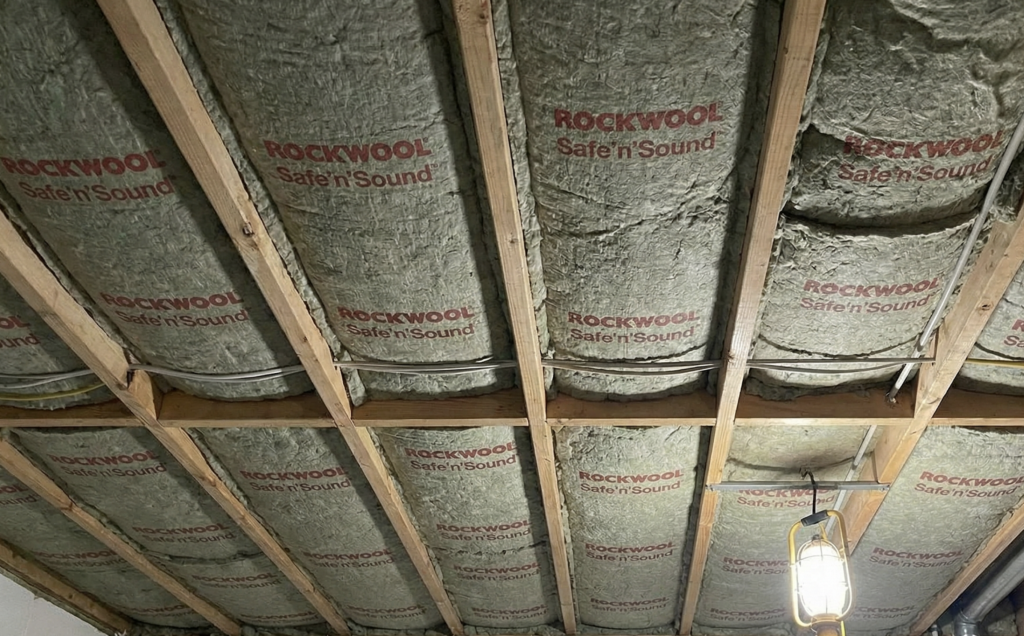
If you want true peace and quiet, the industry secret is to skip the spray foam for interior acoustic walls and use Rockwool mineral wool insulation instead.
Rockwool is a premium stone wool product spun from volcanic rock. It is designed specifically to tackle the exact noise problems Calgary homeowners face. Here is why it completely outperforms spray foam for soundproofing:
1. Unmatched Sound Absorption
Soundproofing requires mass and density to absorb sound waves and prevent them from bouncing. Rockfon mineral wool is significantly denser than open-cell spray foam. Its unique non-directional fiber structure traps sound waves, drastically reducing both airborne noise (voices, TVs) and impact noise (footsteps on the floor above).
2. Fire Protection and Safety
If you are figuring out how to meet Calgary building code for legal basement suites, fire separation is just as important as soundproofing. Because Rockwool is made from stone, it is non-combustible. It can withstand temperatures above 1000°C (1800°F) without melting, providing a critical fire barrier between a basement suite and the main floor—something highly combustible foams cannot do without special thermal barriers.
3. Moisture and Mold Resistance
Calgary basements can occasionally be prone to dampness. Unlike traditional fiberglass that clumps when wet, or certain foams that can trap moisture against wood joists, stone wool is naturally moisture-repellent. It allows the wall cavity to breathe, preventing mold and mildew growth.
4. Friction-Fit Installation
Spray foam requires specialized rigs, chemical mixing, and vacating the house for 3 days due to off-gassing. Rockwool batts are simply cut to size and friction-fitted between your joists and studs. They stay firmly in place without sagging over time, ensuring there are no acoustic “leaks.”
The Ultimate Calgary Soundproofing Stack
To get the absolute best results for your Calgary home or legal suite, we recommend a multi-layered approach:
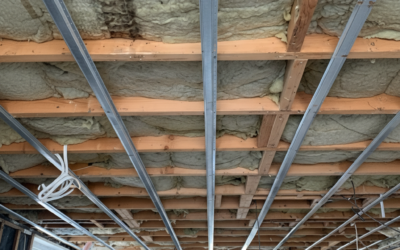
- Rockwool Mineral Wool: Installed snugly between the floor joists or wall studs to absorb internal sound vibrations.
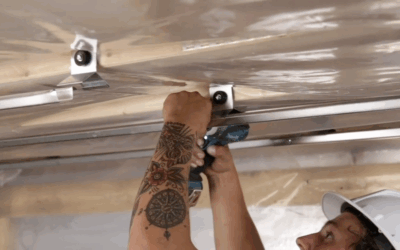
- Resilient Channel: Metal channels applied across the joists to “decouple” the ceiling from the floor above, stopping impact noise dead in its tracks.
- Acoustic Drywall: A heavy, specialized drywall (like 5/8″ Type X) to add the final layer of mass.
Rethink Your Insulation Strategy
Spray foam is fantastic for exterior walls where keeping the Calgary cold out is your number one priority. But when it comes to interior walls, ceilings, and legal suites, acoustic performance is the goal.
Don’t compromise your peace and quiet with the wrong material and hire a professional soundproofing company. Not your jack-of-all-trade
Learn more at https://inaudible.ca/residential/