If you live in a high-rise in Liberty Village or modern infill in Altadore, you already know the primary drawback of Canadian urban density: your neighbours lifestyle is your soundtrack. Whether it’s rhythmic thought or footsteps of the low frequency home of a home theatre, the noise transmission between floors is the #1 complaint in modern Canadian builds.
At Inaudible, we don’t just muffle noise; we engineer quiet oasis. Understanding the difference between the Ontario Building Code (OBC) and the National Building Code of Canada (NBCC) requirements is the first step toward actual silence.
“Soundproofing isn’t just about adding layers; it’s about breaking the physical path of vibration. If you don’t decouple the structure, you’re just building a louder drum.”
Pascal Fonatine-Ferrand, Inaudible’s founder
the science of silence: STC vs. IIC in the Canadian climate
To solve the noise problem in Toronto and Calgary, we must address two distinct types of sound:
- Airborne Noise (STC): Voices, TV, and music. The NBCC Section 5.8 requires a minimum ASTC (Apparent Sound Transmission Class) of 47. However, at 47, you can still hear a loud conversation. We target 60+.
- Impact Noise (IIC): Footsteps, dropped objects, and furniture moving. This is structural vibration. Most Canadian condos barely meet the bare minimums, leading to “Impact Fatigue” for residents.
Inaudible’s tiered assembly systems
We have vetted and proven our four distinct installation methods tailored to address the unique noise challenges encountered in Toronto and Calgary’s houses and condo units. Whether you’re working with wooden floor joists in a Victorian renovation or concrete ceilings in a modern high-rise, these tiers provide a clear path to silence.
Soundproofing Performance Comparison
| Tier | Service Name | Ideal For | Performance Target | Ceiling Height Loss |
| No drywall removal solution | Dense-Fill Injection | Landlords & Budget Fixes | Up to 56 STC | 0″ (No loss) |
| 1 | The Good (Quiet the Chatter) | Improved Privacy for Rentals | 58 STC / 58 IIC | 2″ |
| 2 | The Better (Muffle the Mayhem) | Standard Condo Living | 65 STC / 66 IIC | 4″ |
| 3 | The Best (Tame the Thunder) | Home Theaters & Luxury Suites | 75+ STC / 75 IIC | 6″+ |

Download our 2025 Acoustical Contractor’s Guide to see the full technical cross-sections, decibel ratings, and fire-resistance breakdowns for every tier.
Dense fill ceiling soundproofing solution
This is our most requested service for Toronto landlords, as it is the least invasive because there is no drywall removal. If you’re ceiling has an existing cavity, we inject cellulose insulation at a high density.
- The Benefit: No drywall removal, this means quicker installation times, which in turn shorten the time your space has construction mess.
- The Catch: It excels at airborne noise, but only offers moderate protection against heavy footfalls (vibration).
Tier 1: The “Good” Option – Quiet the Chatter
This is our entry-level structural upgrade. It’s designed for homeowners who want a noticeable improvement without a massive construction footprint.
- The Method: We install Resilient Channels to conserve ceiling height as they are specially shaped metal rails that act like a shock absorber between your new ceiling and the floor above.
- Best For: Stopping “airborne” noise like loud conversations, TV audio, and general apartment chatter.
- The Result: A significant jump in privacy for a minimal loss of ceiling height (only 2 inches).
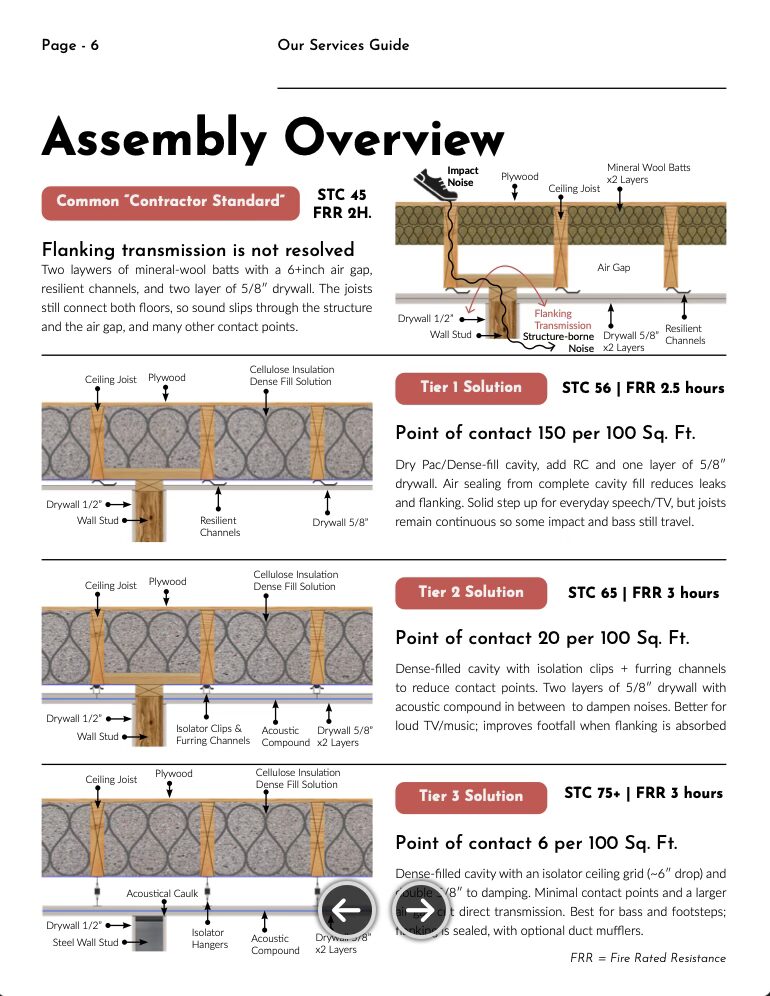
See how our Tier 1 (STC 56) compares to the common ‘Contractor Standard’ (STC 45).
Tier 2: The “better” option – muffle the mayhem
If you own your condo or home and plan to stay for a long-term, this is the sweet spot for performance and value. It addresses both voices and the dreaded “thump” of footsteps.
- The Method: we use high-performance isolation clips to completely “decouple” (detach) your new ceiling from the buildings frame. We then add a layer of acoustic compound between the sheets of drywall layers. This special compound turns sound energy into tiny amounts of heat, stopping noise in its tracks.
- Best For: Active households, noisy upstairs neighbours, and reducing the sound of heavy footsteps or impact vibrations from chairs dragging and objects falling.
- The Result: A professional grade barrier that makes your home feel like a private sanctuary (only 4 inches ceiling height loss).
Tier 3: The “best” option – tame the thunder
this is the ultimate solution for those who demand total silence. If you are building a high-end home theatre or simply cannot tolerate any noise from above, this is the assembly you need.
- The Method: we build what is essentially a “floating ceiling.” using heavy duty hanger isolators, we suspend your entire ceiling on a system of anchors and cables. This removes almost every physical point of contact were sound could travel.
- Best For: High-end home theatres using top-notch surround sound systems, professional, Studios, or luxury suites where peace and quiet is a non-negotiable requirement.
- The Result: This system achieves the highest level of sound isolation possible, resulting in only a slight loss of about 6 inches in ceiling height.
local building codes: what you need to know
In Canada, building codes are a floor, not a ceiling.
- Toronto/Ontario: The OBC is strict on fire-rating. All our assemblies use 5/8″ Fire-Rated Drywall and Acoustical Putty Pads on electrical fixtures to maintain the integrity of your firewall while blocking sound.
- Calgary/Alberta: Temperature fluctuations can cause structural shifting. Our use of Acoustical Sealant (non-hardening caulk) ensures your soundproofing doesn’t crack or leak as the building breathes.
Avoid “Soundproofing Paint.”
In the 2026 market, there are still companies selling “acoustic paint.” Scientifically, it does nothing for STC or IIC ratings. Don’t waste your budget on 1mm of pigment when you need 5/8″ of mass.
Want to see the engineering behind the silence?
Our full Acoustical Services Guide provides detailed technical cross-sections for every assembly, showing exactly how we reduce structural contact points from 150 per 100 sq. ft. down to just 6. Inside the Technical Guide:
- Performance Targets: See the laboratory-style STC/IIC targets for speech, music, and heavy impact noise.
- Assembly Summaries: Full material lists including Dense-Fill cellulose, isolation clips, and acoustic compounds.
- Fire Safety: Review the Fire Rated Resistance (FRR) specs for each tier, ranging from 2.5 to 3 hours.
Get the full Service Guide (PDF)
Ready to restore your peace of mind?
Whether you are in a downtown Toronto condo or a Calgary suburban estate, Inaudible provides the technical expertise to reclaim your space.