Key Takeaways
Inaudible Inc. delivers professional Toronto soundproofing services targeting urban noise pollution directly.
We install 5/8-inch Type X gypsum and multi-layer drywall systems to add effective mass to noisy walls.
Our team combines soundproof drywall with retrofit assemblies, addressing STC ratings for bedrooms, offices, and basements.
Pascal Fontaine-Ferrand leads our Toronto soundproofing solutions, creating tranquil spaces for both residential and commercial clients.
1. The Amazon Acoustic Foam Trap
Room echo, hollow-sounding calls, harsh open-concept spaces → acoustic absorption panels, rated in NRC.
Footsteps, voices, bass, or plumbing noise arriving from another room or unit → structural sound insulation, rated in STC and IIC — panels do next to nothing here.
Permanent noise separation between units or floors requires mass, decoupling, and damping engineered into the wall or ceiling assembly itself, which is where Inaudible's non-invasive dense-fill retrofits come in.
2. The Diagnostic Matrix: Room Echo vs. Neighbor Sound Transmission
Symptom | What's Actually Happening | The Right Fix |
|---|---|---|
Zoom calls sound hollow, boomy, or like you're in a stairwell | Sound is bouncing off hard, parallel surfaces inside your own room (reverberation) | Acoustic absorption panels (NRC) |
An open-concept living room feels loud even in normal conversation | Hard floors, glass, and drywall reflect sound instead of absorbing it | Acoustic absorption panels (NRC), placed strategically |
Footsteps or dragging furniture from the unit above | Impact vibration is traveling through the joists into your ceiling | Dense-fill ceiling soundproofing (IIC) |
Neighbor's voices, TV, or bass through a shared wall | Airborne sound energy is passing through the wall assembly | Dense-fill wall soundproofing (STC) |
Plumbing, HVAC, or mechanical noise from another unit | Vibration is traveling through structural connections | Decoupled, mass-loaded assembly upgrades |
3. NRC vs. STC Explained: The Physics of Why Panels Can't Block Sound
Property | Noise Reduction Coefficient (NRC) | Sound Transmission Class (STC) |
|---|---|---|
What it measures | Sound absorbed inside a room | Sound blocked between two spaces |
Fixes | Echo, reverberation, "live" rooms | Neighbor noise, voices, footsteps through structure |
Typical products | Foam panels, fabric-wrapped fiberglass, wood-slat panels | Dense-fill insulation, mass-loaded drywall, decoupled framing |
Effect on upstairs footsteps | None | Directly addressed (paired with IIC) |
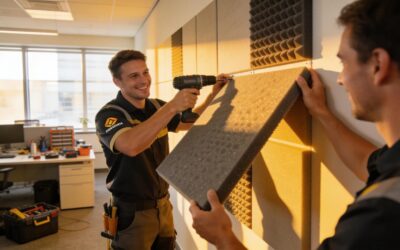
Engineering tip: If someone asks “do acoustic panels block noise through a wall?” the honest, physics-based answer is no — not meaningfully. A 2-inch foam panel typically adds an STC improvement of 1–2 points at best, which is inaudible to the human ear. Real STC gains start with mass and decoupling, not surface absorption.
4. When ARE Acoustic Panels Appropriate?
5. The 3 Pillars of True Sound Blocking
6. Non-Invasive Retrofits: How Inaudible Solves It Without Gutting Your Home
7. Impact Noise vs. Airborne Noise: How to Soundproof a Ceiling the Right Way
8. Cost & Value: Cheap Fixes vs. Permanent Equity
Approach | Typical Cost | What It Actually Fixes | Long-Term Value |
|---|---|---|---|
Decorative foam/wood-slat acoustic panels | $500–$1,500 | Room echo and reverberation only | Cosmetic upgrade; no impact on neighbor noise |
Traditional demolition-based soundproofing | $18–$28 per sq. ft. | Airborne + impact noise, once cavity is open | Permanent, but weeks of disruption and rebuild costs |
Inaudible non-invasive dense-fill retrofit | Typically less than full demolition, most rooms in a day | Airborne (STC) and impact (IIC) noise through the existing structure | Permanent, lab-tested, no displacement or rebuild |