
BASEMENT NOISE CONTROL
Basement Soundproofing in Toronto
Reduce unwanted sound travelling between your basement and the rest of the home with solutions designed around the way the noise is actually moving through the building.
Inaudible works with finished basements, basement apartments, family spaces and home theatres across Toronto and the GTHA—addressing footsteps, voices, music, shared walls and other common sound-transfer problems.
START WITH THE NOISE
Basement Soundproofing Starts With the Problem You Hear
The same basement can experience several different types of sound transmission. Identifying the dominant noise path helps determine which treatment makes sense.
Footsteps & Overhead Impact
Footsteps, dropped objects and movement from the floor above can travel through the structure into the basement ceiling.
Voices, TV & Music From Upstairs
Airborne sound can move through floor and ceiling cavities, penetrations and connected construction.
Shared & Party Wall Noise
Voices and everyday household noise can pass through basement walls shared with adjoining spaces or neighbouring homes.
Basement Suites & Entertainment Spaces
Basement apartments, home theatres and recreation rooms may require sound control in both directions—reducing sound entering the basement and sound leaving it.
THE DISTINCTION MATTERS
Not All Basement Noise Travels the Same Way
Airborne Noise
Voices, television, music and similar sounds begin in the air as sound energy waves.
These sounds can pass through drywall, floor cavities, wall cavities, electrical penetrations and other openings within the assembly.
Depending on the existing construction, treatment may involve cavity insulation, additional mass, sealing and other sound-isolation components.
Impact Noise
Footsteps, furniture movement and dropped objects physically excite the building structure.
This is also called structure-borne noise. That vibration can travel through joists, framing and connected surfaces before radiating as sound into the basement below.
Because the structure itself is involved, impact noise may require isolation or decoupling measures beyond cavity insulation alone.
The right solution depends on how the sound is travelling—not simply where you hear it.


BETWEEN FLOORS
Reducing Noise Through the Basement Ceiling
The basement ceiling is often the separating assembly between two actively used parts of the home. Depending on the problem, homeowners may be trying to reduce voices and television travelling downward, footsteps from above, or sound from a basement apartment or theatre travelling upward.
The appropriate assembly depends on the existing ceiling, joist construction, cavity condition and whether the dominant problem is airborne or structure-borne.
For airborne transmission
Filling an empty joist cavity can be one useful component of the system.
Airborne sound such as voices, television and music can travel through open or lightly insulated cavities between floors. Treating the cavity can help reduce this transmission as part of the overall assembly.
For stronger impact or vibration problems
A more substantial ceiling assembly may incorporate isolation systems like clips, channels, or hangers combined with added mass, damping materials and careful perimeter sealing.
*Performance varies by cavity depth, assembly construction, installation density and flanking paths.
%
Dense Fill Solution
Reduces Sound Power by up to 60%
Basement ceiling joist cavities provide substantial space for acoustic insulation. Our Dense-Fill solution packs cellulose throughout the available cavity to help reduce airborne sound travelling between floors—without removing the existing drywall.
Manufacturer-reported field testing of cellulose cavity treatment has demonstrated up to a 60% reduction in sound power.¹
Planning to Finish an Unfinished Basement?
If the ceiling and wall framing are still exposed, soundproofing can be coordinated before drywall and finishes are installed. This stage creates more options for cavity insulation, isolation assemblies, sealing and floor/ceiling construction because the framing is still accessible. For larger renovations or projects being planned before close-up, Inaudible can help coordinate the acoustic strategy earlier in the construction process.
WHEN THE DRYWALL IS ALREADY FINISHED
Soundproofing Without Tearing Apart the Basement
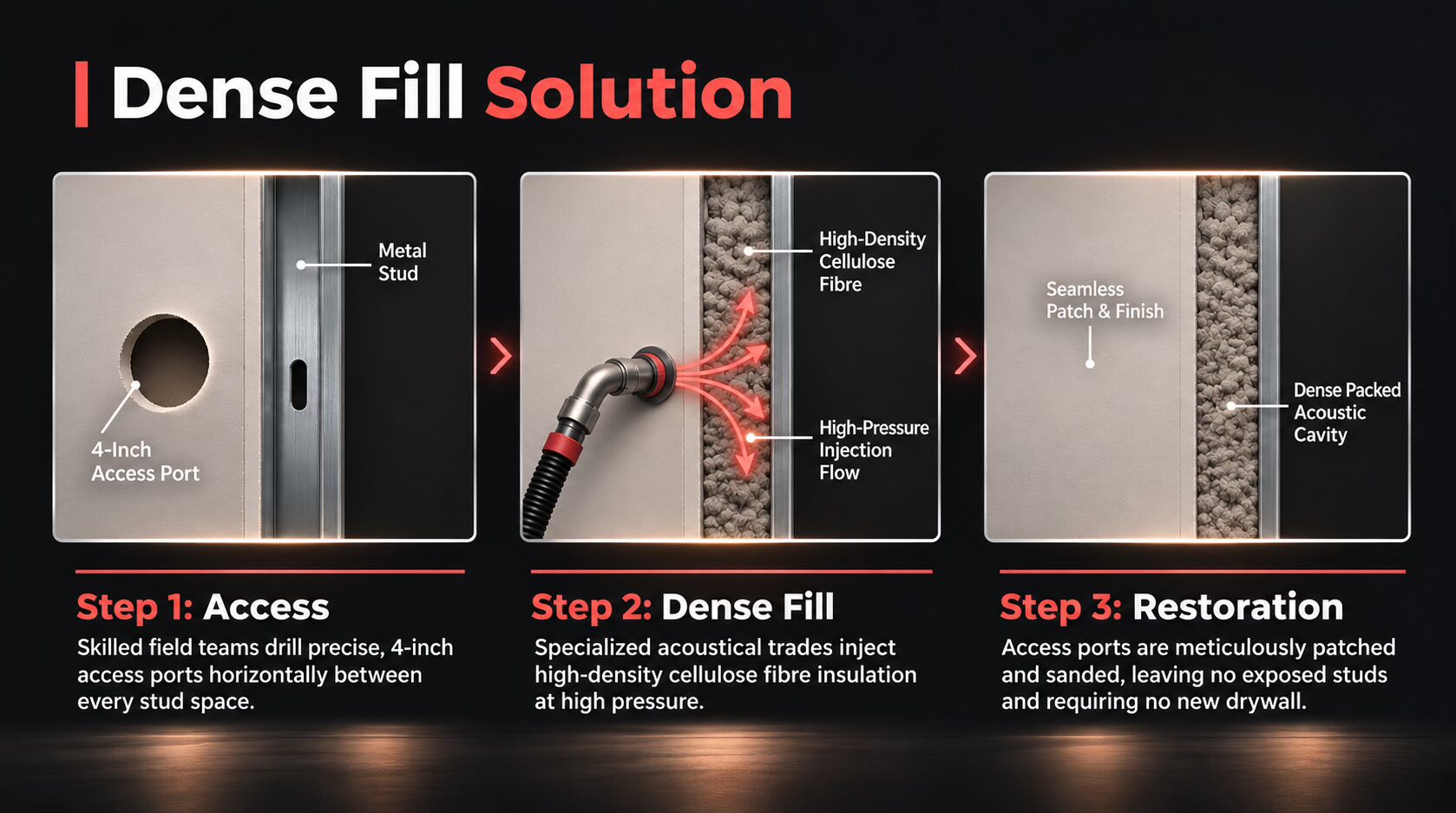
A finished basement does not always need to be stripped back to the framing before acoustic improvements can be considered. Where empty wall or ceiling cavities are contributing to airborne sound transmission, Inaudible’s Dense-Fill solution can often be installed through controlled access ports in the existing drywall.
Dense-pack cellulose is installed into the enclosed cavity, after which the access points can be patched. This approach can be particularly useful when homeowners want to improve cavity conditions without undertaking a complete demolition and rebuild.
It is not a universal solution for every basement noise problem. Footstep and vibration complaints may require additional isolation measures depending on the structure.
Existing finished surface → access ports → installation → patched surface.
BASEMENT APARTMENT & RENTAL SUITE SOUNDPROOFING
Creating Better Separation Between Living Spaces
Basement apartments create a different acoustic challenge because two households may be using the same structure at the same time.
Common complaints include conversations travelling between floors, footsteps from the main level, televisions and entertainment systems, plumbing noise and sound passing through shared stairwells or connected walls.
The goal is usually not simply to treat one surface. It is to improve the separation between the basement suite and the living space above by identifying the dominant sound paths.
Depending on the existing construction, the scope may include:
ceiling cavity treatment
isolated ceiling assemblies
wall cavity treatment
sealing penetrations & perimeter gaps
door treatments
targeted work at connected flanking paths
SITE-SPECIFIC BASEMENT SOUND CONTROL
A Layered Approach to Basement Soundproofing
Effective soundproofing requires a combination of materials and techniques. There is no single basement assembly that solves every noise problem. We take a layered approach, addressing the floor, ceiling, walls, mechanical systems, and all perimeter points to achieve the best results for your space.
Inaudible selects the treatment according to the type of sound, the existing construction and the path connecting the two spaces. Some projects require only targeted cavity treatment. Others require more substantial isolation between floors or rooms.
When a Higher-Isolation Is Assemblies Are Needed
For basement apartments, home theatres, or spaces with significant noise challenges, we use higher-isolation assemblies designed to deliver maximum noise reduction.
Dense-Fill Cavity Treatment
Existing wall and ceiling cavities can often be treated with dense-pack cellulose through controlled access ports where airborne sound transmission is the primary concern.
Ceiling Isolation Assemblies
Isolation clips, channels, additional mass and damping materials can be incorporated where greater separation or structural isolation is required.
Walls, Doors & Perimeter Sealing
Shared walls, doors, penetrations and perimeter gaps can create secondary sound paths that weaken the overall enclosure.
Advanced Floor / Ceiling Isolation
More demanding projects may require a coordinated assembly addressing the cavity, ceiling membrane, structural connection and surrounding flanking paths.
WHAT property owners SAY
Real Basement Soundproofing Projects
Google Reviews
“We had a great experience with Inaudible! Pascal was excellent with communication from start to finish—always quick to respond and very clear throughout the process. His crew, Anthony and the team, were extremely professional, efficient, and respectful while completing the work.
We had our basement unit ceiling insulated and immediately noticed a significant reduction in noise, which made a huge difference. Everything was handled smoothly, and we couldn’t be happier with the results. Highly recommend Pascal and his team if you’re looking for reliable, top-notch service!”
Vincent Wu
Landlord
“We hired Inaudible to soundproof the basement ceiling and ground floor ceiling in our triplex in Dovercourt, Toronto. As an investment property, minimizing disruption and downtime mattered a lot to us, and Inaudible delivered. They were in and out in just 4 days for both apartments. They didn’t need to remove any drywall. The work was done through the existing ceilings, and they handled all the patching, plastering and painting afterwards. The finish looks clean, as if nothing had been done.
The difference in sound between units is significant, and footsteps from the units above are greatly reduced. It makes the units more comfortable for tenants and gives us real peace of mind as owners.
The overall experience with Inaudible was great: professional, tidy, and easy to work with. I’d recommend them to any landlord or property owner in Toronto dealing with noise between units.”
Shannon Douma
Landlord
“Pascal and his team showed real professionalism. We reached out to Pascal to soundproof the basement apartment, and from the beginning, he was very helpful, providing us with several installation options. They also maintained cleanliness throughout the process.”
Michael Pinto
Landlord
FROM NOISE PROBLEM TO SOUNDPROOFING PLAN
How We Approach Basement Soundproofing
Step 1
Identify What You Are Hearing
We begin with the actual complaint: footsteps, voices, television, shared-wall noise, theatre sound or another source.
Step 2
Determine How the Sound Is Travelling
We distinguish airborne transmission from impact and structure-borne noise and review the walls, ceiling, joists and connected construction involved.
Step 3
Build the Appropriate Treatment
The recommended scope may include cavity treatment, ceiling isolation, additional mass, sealing or a combination of measures depending on the dominant transmission paths.
Step 4
Install & Restore
The selected solution is installed with consideration for the existing basement. Where access points or finishes are affected, treated areas are restored according to the agreed scope.
BASEMENT SOUNDPROOFING FAQS
Questions About Basement Noise & Soundproofing
What is the best way to soundproof a basement ceiling?
There is no single best assembly for every basement. The correct approach depends on whether the dominant problem is airborne sound, impact noise or a combination of both, as well as the existing joist and ceiling construction.
Can you soundproof a basement ceiling without removing the drywall?
Some existing enclosed cavities can be treated through controlled access ports using Dense-Fill cellulose without removing the complete drywall surface. This approach primarily addresses cavity conditions and airborne sound. More substantial impact-noise problems may require additional isolation work.
Will insulation stop footsteps from upstairs?
Cavity insulation can help control airborne sound within an assembly, but footsteps are primarily an impact and structure-borne problem.
Where impact noise is significant, isolation or decoupling measures may also be required.
How do you reduce voices between a basement and the floor above?
The solution may involve treating the floor/ceiling cavity, increasing mass, sealing penetrations and addressing flanking paths around the separating assembly.
Can you soundproof a finished basement?
Yes. Some retrofit options can be applied to finished spaces with limited access to the existing assembly, while other problems may require more invasive construction.
What about soundproofing a basement apartment?
Basement suites often require attention to both airborne and impact transmission between living spaces. The ceiling, walls, doors, stairwell and connected construction may all contribute.
Can a basement home theatre be soundproofed?
Yes. Home theatres typically require a more comprehensive approach because low-frequency sound and higher playback levels place greater demands on the surrounding assemblies.
RELATED RESIDENTIAL SOLUTIONS
Explore Related Soundproofing Services
Dense-Fill Soundproofing
A no-demolition cavity treatment for suitable existing walls and ceilings where airborne sound transmission is part of the problem.
Ceiling & Floor Soundproofing
Technical solutions for airborne, impact and structure-borne transmission between levels.
Home Theatre & Music Room Soundproofing
Higher-performance isolation strategies for entertainment and high-output sound environments.
GET GUIDANCE
Not Sure Which Part of the Basement Is Carrying the Noise?
Basement sound can travel through ceilings, walls, joists, doors and connected building components. A consultation can help identify the dominant transmission paths and determine which level of intervention makes sense for your home.