
Dense-Fill Soundproofing for Existing Walls & Ceilings
NO-DRYWALL-REMOVAL CAVITY RETROFITTreat suitable enclosed wall and ceiling cavities with high-density cellulose—without removing entire sheets of drywall or rebuilding the room. Inaudible’s Dense Fill Solution is designed primarily for finished residential and commercial spaces where airborne sound is travelling through hollow or lightly insulated cavities and full demolition is undesirable. Controlled access ports allow us to dense-pack the existing cavity, patch the access points and keep the original wall or ceiling largely intact. Dense Fill projects start at $2,900.
ONE SOLUTION — DIFFERENT SETTINGS
Dense-Fill Is Not Just a Residential Service
The installation method is shared across different building types. What changes is the space, the noise problem and the construction surrounding the cavity. Where framing is already open, we normally approach the cavity differently using an open-cavity dry-pack installation rather than drilling access ports into finished surfaces.
Residential
Finished walls and ceilings in condos, houses, basements, party walls and other occupied spaces where removing the existing drywall is undesirable.
Commercial
Existing offices, treatment rooms, tenant spaces and other finished commercial interiors where cavity treatment can form part of a larger speech-privacy or noise-control retrofit.
Renovations & Additions
Dense Fill can also be useful where part of a renovation remains finished and the existing drywall is being preserved. When framing is open, we usually use the dry-pack method for cavity spaces.
%
REDUCTION IN SOUND POWER
FILL THE CAVITY — KEEP THE DRYWALL
Soundproof the Space Behind the Finished Surface
Empty and lightly insulated cavities can allow airborne sound energy to move through an assembly. The Dense Fill Solution uses a dense-pack installation technique to fill the available enclosed cavity with cellulose through controlled access points in the existing drywall.
Because the surface does not need to be completely removed, the installation can significantly reduce the amount of demolition, debris and rebuilding associated with conventional cavity upgrades.
Many single-area retrofit projects can be completed within one to two days, depending on size, access and site conditions.
Manufacturer-reported field testing of cellulose cavity treatment has demonstrated up to a 60% reduction in sound power in tested assemblies.¹
Actual performance depends on the complete assembly, cavity conditions, installation density and surrounding flanking paths.
Improve the Existing Assembly Without Turning It Into a Full Renovation
When a finished wall or ceiling needs cavity treatment, the conventional route is to open the assembly, expose the framing, install the insulation and then rebuild the surface. Dense Fill approaches the same enclosed cavity from the finished side using controlled access points.
Comparison chart
Dense-Fill vs. Traditional Tear-Out
Using the dense-pack technique, cellulose is installed into accessible wall or ceiling cavities through controlled access points in the existing surface. The cavity can be treated without removing entire sheets of drywall or rebuilding the room from the framing out.
Traditional Tear-Out
Dense-Fill Cavity Retrofit
Existing drywall
Removed and replaced later
Remains in place
Cavity access
Wall or ceiling opened completely
Small controlled access points
Insulation installation
Installed while framing is exposed
Dense-packed into the enclosed cavity
Drywall work
New board, taping, mudding and sanding
Access points patched and prepared for finishing
Paint work
Full wall or ceiling typically requires refinishing
Localized touch-ups
Construction debris
Removing drywall and insulation generates additional waste, so a waste disposal bin is necessary.
Significantly less waste as there was no full drywall tear-out
Room disruption
Broader renovation scope where furniture relocation and full space clean-out is required
Targeted retrofit designed to minimize disruption in occupied spaces
Typical timeline
Weeks, dependent on demolition, rebuilding, and finishing
Many single-area projects completed in 1–2 days
Best suited for
Major renovations or assemblies already being rebuilt
Finished homes where demolition is undesirable
THE RETROFIT PROCESS
From Finished Surface to Filled Cavity
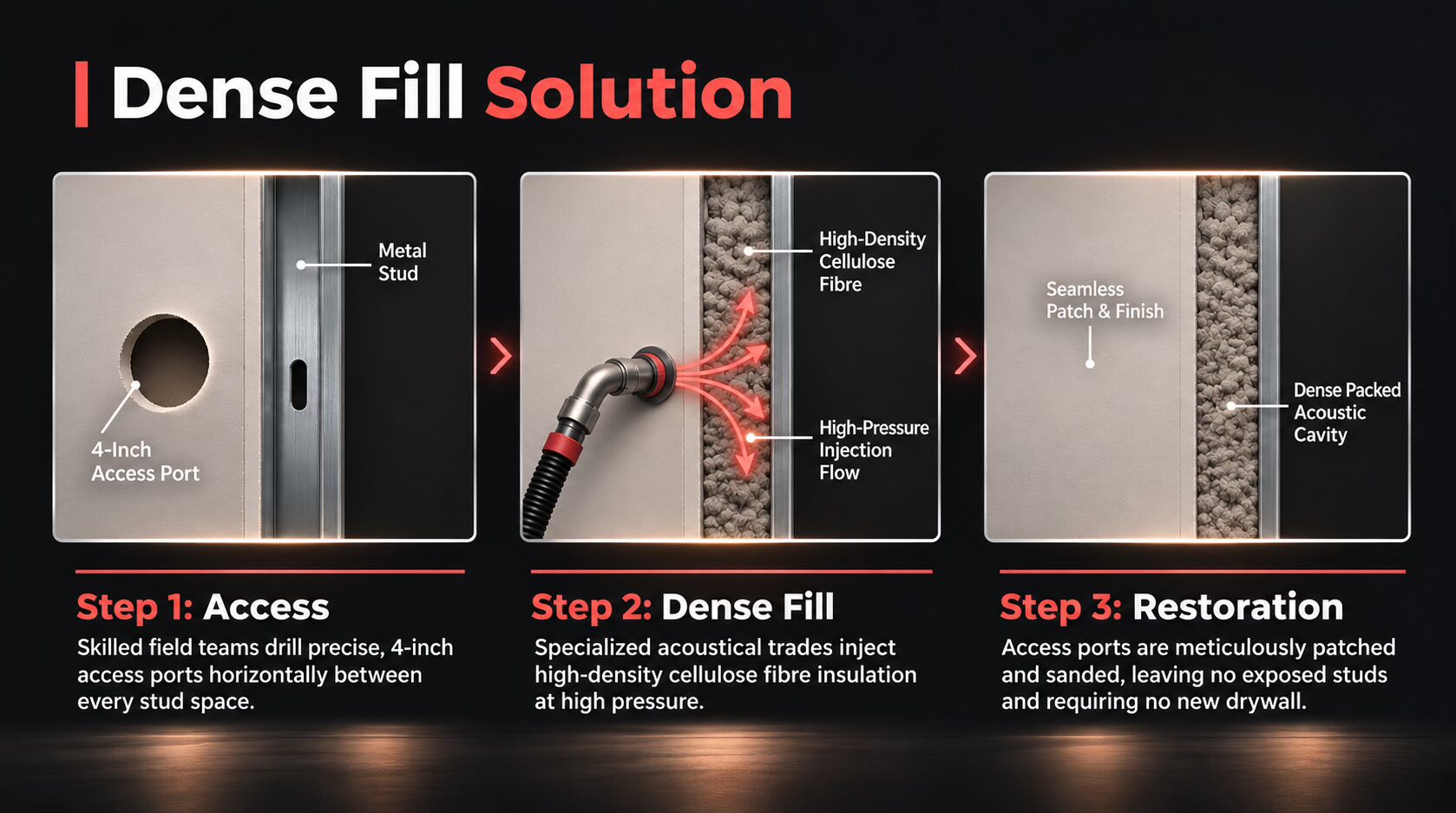
Step 1
Precision Access
We create discreet 4-inch access points for each cavity within your walls or ceilings to facilitate our soundproofing injection without disrupting your space.
Step 2
High-Density Injection
Our specialized Dense-pack machine injects cellulose at high velocity, achieving a high density insulation installation that maximizes sound transmission loss, transforming your walls into high-STC assemblies.
Step 3
Patch & Finish
Ports are sealed, compounded, and prepped smooth for seamless paint matching. Completing the dense-fill solution in a little as a single day.
THE PROJECT STAGE CHANGES THE METHOD
Dense Fill Retrofit vs. Open-Cavity Dry-Pack
Existing Enclosed Walls & Ceilings
The Dense Fill Solution is primarily a retrofit method.
When drywall or another finished surface is already installed and worth preserving, controlled access ports allow cellulose to be densely packed into the enclosed cavity.
This is the service most clients mean when they contact Inaudible about Dense Fill soundproofing.
Best suited for:
finished homes, offices, basements, condos and existing tenant spaces.
Open Framing Before Drywall
When wall or ceiling framing is still open, there is no reason to drill through drywall that has not been installed yet.
For suitable projects, cellulose can instead be dry-packed into the open framing behind a retaining smart membrane before the assembly is closed.
This approach is more relevant to renovations, additions and selected high-performance or sustainability-focused builds.

THE CAVITY MATERIAL MATTERS
Why We Start With Cellulose for Suitable Airborne-Sound Cavities
Insulation Choice Can Affect the Complete Wall Assembly
Insulation is only one component of a sound-isolation system, but the cavity material can influence the performance of the complete wall. Published testing shows that cavity insulation can influence the STC performance of the complete wall assembly.
The cellulose assembly achieved the highest STC rating in the referenced comparison—one reason Inaudible prioritizes cellulose as the acoustic insulation of choice.
Insulation Sound Comparison
BAR SCALE: STC 0–75
- DENSE-PACKED CELLULOSE — STC 51¹
- Mineral Wool BATTS — STC 46²
- FIBERGLASS BATTS — STC 46¹
- OPEN-CELL SPRAY FOAM — STC 37¹
Dense Cavity Coverage
Blown cellulose can be packed throughout irregular cavities and around obstructions, helping limit the voids and gaps that can weaken cavity treatment.
Acoustic Performance
The material’s density and ability to fill the available cavity make cellulose a strong choice when airborne speech, television and similar sounds are travelling through a suitable wall or ceiling assembly.
Material & Sustainability Attributes
Our preferred cellulose products are manufactured with high recycled-content levels and have environmental documentation available for projects where material selection and sustainability objectives matter.
SUITABILITY MATTERS
Strong for Airborne Cavity Noise — Not a Universal Fix
Dense Fill May Be a Good Fit When:
drywall is already installed and worth preserving
an accessible wall or ceiling cavity is hollow or lightly insulated
voices, television or other airborne sound are part of the complaint
full demolition is undesirable
cavity treatment is one component of a broader soundproofing retrofit
Another Solution May Be Needed When:
footsteps or structural vibration are the dominant problem
significant flanking paths bypass the treated cavity
low-frequency sound requires greater isolation
the wall or ceiling requires additional mass or structural decoupling
the framing is already open and a pre-drywall assembly can be designed instead
Dense Fill is often a strong first layer, but it is not a substitute for isolation clips, added mass, damping or other assembly improvements when the noise problem requires them.
STARTING PROJECT PRICE
Dense Fill Projects Start at $2,900
Small Dense Fill scopes that fall below our standard measured project size are subject to a $2,900 minimum project rate.
Larger projects are quoted according to the area being treated, cavity conditions, access requirements and overall scope.
Typical small projects may include a single party wall, selected office partitions or a smaller ceiling area.
REAL DENSE FILL RETROFITS
What Clients Say After the Work
DENSE FILL Solution FAQS
Questions About Dense-Fill Soundproofing
What is the Dense Fill Solution?
The Dense Fill Solution is Inaudible’s enclosed-cavity retrofit using dense-pack cellulose installed through controlled access ports in existing walls or ceilings.
It is primarily used where the finished surface is being preserved and airborne sound transmission through the cavity is part of the problem.
Do you remove the drywall?
No. Full sheets of drywall normally remain in place.
Controlled access ports are created to reach the cavity and are patched after the cellulose installation.
How much noise can Dense Fill reduce?
Manufacturer-reported field testing of cellulose cavity treatment has demonstrated up to a 60% reduction in sound power in tested assemblies.¹
Actual results depend on the complete wall or ceiling assembly, installation conditions and surrounding transmission paths.
Can Dense Fill be used in commercial offices?
Yes.
Suitable existing commercial walls and ceilings can be treated using the same enclosed-cavity technique, often as one component of a broader office speech-privacy or soundproofing project.
Can Dense Fill be used during renovations or new construction?
Yes, although the installation method may change.
Where existing drywall is being retained, the Dense Fill retrofit method can be appropriate. Where framing is open, cellulose can instead be dry-packed behind a retaining membrane before drywall installation.
Will Dense Fill stop footsteps?
Dense Fill primarily helps with airborne sound within a floor/ceiling cavity, but footsteps are impact and structure-borne noise. Therefore, it will only have some meaningful footfall noise reduction.
More substantial ceiling or floor isolation may be required where impact transmission is the dominant problem.
How much does Dense Fill cost?
Dense Fill projects currently start at $2,900.
Final pricing depends on the size of the area, cavity conditions, access and overall project scope.
IS DENSE FILL RIGHT FOR YOUR SPACE?
Start With the Cavity — Then Look at the Whole Assembly
If airborne sound is travelling through an existing wall or ceiling and you want to avoid a major teardown, Dense Fill may be the right place to start.
Tell us what you are hearing, where it is coming from and whether the space is already finished. We can help determine whether cavity treatment alone makes sense or whether the project requires a more advanced soundproofing assembly.