
WALL SOUNDPROOFING Systems
Wall Soundproofing Systems for Existing & New Walls
Reduce sound transmission between rooms, neighbouring spaces and adjoining units with wall solutions selected around the existing construction, noise source and level of isolation required.
From non-invasive cavity retrofits to advanced decoupled wall assemblies, Inaudible builds the solution around the wall you already have—or the wall you are preparing to build.
WHAT ARE YOU HEARING?
Different Noise Problems Can Require Different Wall Solutions
Sound travelling through a wall is not always caused by the same weakness. Before recommending materials or opening the wall, we first consider what is being heard, where it is coming from and how the existing partition is constructed.
VOICES & CONVERSATION
Speech, television and everyday activity travelling between bedrooms, offices or neighbouring spaces.
MUSIC & ENTERTAINMENT
Higher sound levels and a broader frequency range from speakers, instruments, home theatres and entertainment rooms.
SHARED-WALL NOISE
Sound travelling through party walls between condos, semi-detached homes, townhomes, rental units or adjoining commercial spaces.
MECHANICAL & EXTERIOR NOISE
Equipment, plumbing, traffic or other noise reaching the room through the wall assembly or connected building elements.
MORE THAN INSULATION
Effective Wall Soundproofing Depends on the Complete Assembly
Adding insulation to a cavity can improve sound absorption inside the wall, but insulation is only one part of the system.
The performance of a wall can also depend on its mass, how strongly the two sides are structurally connected, the treatment of joints and penetrations, and whether sound is travelling around the partition through adjoining building elements.
For that reason, Inaudible does not treat every wall with the same material or construction detail.
CAVITY ABSORPTION
Insulation helps control sound energy inside the wall cavity.
ISOLATION
Clips, channels, hangers or separated framing can reduce the direct mechanical connection between wall surfaces.
MASS & DAMPING
Additional gypsum layers and damping materials can increase resistance to airborne sound transmission.
SEALING
Acoustical sealant and properly treated penetrations help reduce leakage through gaps and weak points.
THREE STARTING CONDITIONS
The Best Approach Depends on What Already Exists
FINISHED WALL
When drywall is already installed and demolition is undesirable, we first determine whether the enclosed cavity can be improved without removing the wall surface.
Dense-Fill Soundproofing may be suitable for qualifying empty or under-insulated cavities.
WALL OPEN DURING RENOVATION
When framing is already exposed, the cavity and wall system can be addressed before drywall is reinstalled.
This may include cavity insulation, isolation components, added mass, damping and detailed perimeter treatment depending on the project requirements.
NEW WALL CONSTRUCTION
When the partition has not yet been closed, the framing and isolation strategy can be coordinated before the finishing stages begin.
This creates the greatest opportunity to address the complete wall assembly from the beginning.
A LOWER-DISRUPTION STARTING POINT
Soundproofing a Wall Does Not Always Require Tearing It Down
Many homeowners and businesses contact us after a room is already finished.When the existing wall cavity is suitable, our Dense Fill Solution allows cellulose to be installed through controlled access ports without removing the drywall. The cavity is densely filled, the access points are patched and the existing wall remains in place.
This approach is particularly useful when the primary concern is airborne sound and the client wants to improve an existing partition without turning the room into a major renovation.
Dense Fill is not the answer for every noise problem. Where greater isolation is required—or where the existing construction has other limitations—we may recommend additional wall-system measures.
ADVANCED WALL ISOLATION
When Cavity Treatment Alone Is Not Enough
Some rooms require a more substantial change to the wall assembly. Higher sound levels, entertainment spaces, privacy-sensitive rooms and partitions with significant structural transmission may require several sound-control principles working together.
The assembly is selected around the actual room and construction—not from a universal material list.
Depending on the wall and project scope, an advanced assembly may incorporate:
Isolation clips or resilient systems to reduce rigid connections between the framing and finished surface.
Furring channels to support a decoupled gypsum layer.
Acoustic cavity insulation to absorb sound energy within the stud space.
Multiple gypsum layers to increase surface mass.
Viscoelastic damping compound between suitable layers to help control vibration.
Acoustical sealant at perimeters, joints and other potential leakage points.
Electrical and service-penetration treatment where openings create weaknesses in the partition.
THE COMPLETE Acoustic wall Strategy
Sound Isolation Comes From Layers Working Together
A higher-performing wall is never created by a single product. Different components solve different acoustic problems.
The objective is to control several ways that sound energy can move through the partition: through the cavity, through the wall surfaces, through rigid structural connections and through gaps or penetrations.
Inside the room, acoustic treatment can be added separately to control reflections, reverberation and sound clarity.
CAVITY ABSORPTION
Insulation helps control sound energy within the wall cavity.
DECOUPLING
Isolation clips and furring channels reduce the direct structural connection between framing and finished wall surfaces.
MASS & DAMPING
Multiple gypsum layers and viscoelastic damping materials help increase resistance to sound transmission and control vibration.
ROOM ACOUSTIC TREATMENT
Mounted acoustic panels manage reflections and reverberation within the occupied room. Their role is different from the wall system used to reduce sound transmission.
DETAILING & SEALING
Perimeters, joints and penetrations are treated to reduce sound leakage through weak points.

Illustrative acoustic strategy showing both sound-isolation components within the wall assembly and acoustic treatment within the finished room. Final systems vary by project.
BETWEEN NEIGHBOURING SPACES
When the Noise Is Coming Through a Shared Wall
Shared walls are common sound-transmission paths in condos, semi-detached homes, townhomes, rental properties and multi-unit buildings.
Typical concerns include voices, televisions, music, bedrooms positioned against neighbouring spaces and general household activity.Where possible, we begin by determining whether the problem can be addressed within the existing wall cavity.
If the situation requires greater isolation, the solution may expand to include additional wall mass, decoupling or treatment of connected building elements.
The goal is not simply to add material. It is to identify the weakest parts of the separation and improve the assembly accordingly.
OFFICES & COMMERCIAL SPACES
Wall Performance Matters When Conversations Need to Stay Between Rooms
Commercial wall soundproofing often begins with speech.Boardrooms, private offices, consultation rooms, therapy spaces, medical offices and other privacy-sensitive environments can be affected when conversations pass through partitions or connected building paths.
Depending on the existing office construction, improvements may involve the wall cavity, wall surface, ceiling plenum, doors, penetrations or mechanical pathways.Wall treatment therefore forms one part of a broader speech-privacy strategy.
DON'T IGNORE THE OTHER PATHS
Not Every Sound You Hear Is Passing Directly Through the Wall
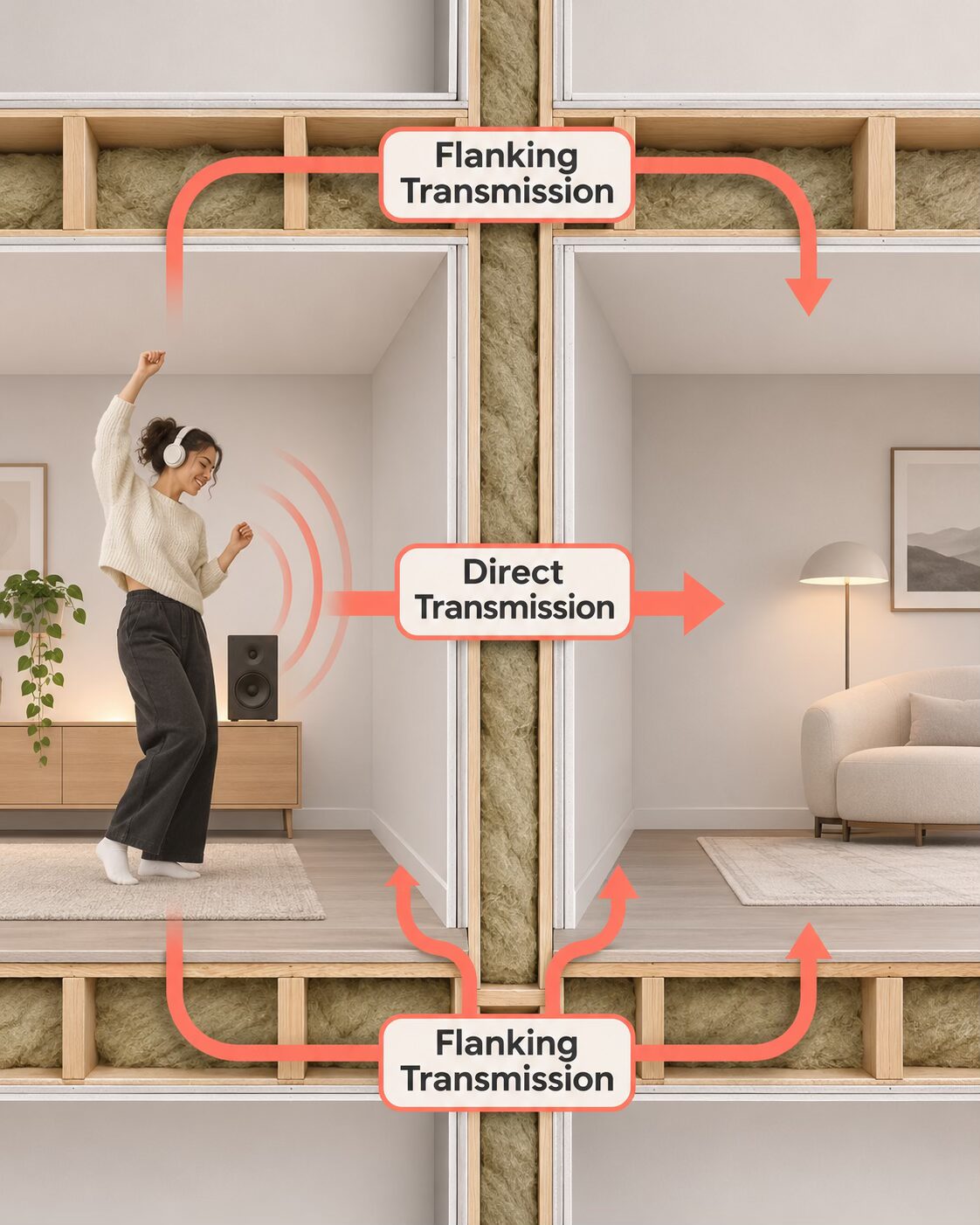
A wall can be improved substantially and still be undermined by another transmission path. Sound may travel through a ceiling plenum, adjoining wall, floor system, duct, door, electrical penetration or structural connection before reaching the receiving room.
These alternate paths are commonly referred to as flanking transmission.
That is why wall soundproofing should be considered as part of the surrounding construction. Where flanking paths are significant, improving the wall alone may not address the full noise problem.
MATCH THE INTERVENTION TO THE PROBLEM
From Cavity Retrofit to Advanced Isolation
CAVITY-FOCUSED RETROFIT
Best considered when the wall is already finished and the cavity itself is an important weakness. Typical approach: Dense Fill Solution.
ENHANCED EXISTING WALL
Used when the existing partition requires more than cavity treatment alone. May involve added mass, damping, isolation or detailed sealing depending on access and construction.
FULL ISOLATION ASSEMBLY
Used when greater isolation is required and the project allows the wall assembly to be rebuilt or designed accordingly. May combine cavity treatment, isolation hardware, multiple wall layers, damping and perimeter detailing.
There is no single wall specification that is appropriate for every building or every noise source.
BUILT IN REAL SPACES
Wall Soundproofing Across Residential & Commercial Projects
Our wall solutions have been used for shared residential partitions, finished-wall retrofits, offices, boardrooms and other spaces where reducing sound transmission between rooms matters.
RESIDENTIAL SHARED WALL
Dense-packed cellulose installed into an existing party wall without full drywall removal.
OFFICE SPEECH-PRIVACY RETROFIT
Wall cavities and connected transmission paths treated as part of a commercial office soundproofing project.
ADVANCED WALL ISOLATION
Layered wall systems incorporating isolation, cavity treatment, added mass and detailed sealing where greater separation is required.
HOW WE SELECT THE WALL SOLUTION
Start With the Building, Not a Product
01 · UNDERSTAND THE NOISE
We identify what is being heard, where it originates and how the room is being used.
02 · REVIEW THE WALL
We consider the existing framing, cavity condition, finishes and access.
03 · CHECK CONNECTED PATHS
Ceilings, floors, doors, ducts, penetrations and adjoining construction are considered where they may affect the result.
04 · SELECT THE APPROACH
We recommend the level of intervention appropriate for the wall, noise problem and project constraints.
Wall Soundproofing FAQs
Questions About Wall Soundproofing Systems
CAN YOU SOUNDPROOF AN EXISTING WALL WITHOUT REMOVING THE DRYWALL?
In suitable enclosed wall cavities, Dense-Fill Soundproofing can often be installed through controlled access ports without removing the existing drywall. Whether this is the appropriate solution depends on the wall construction and noise problem.
IS MINERAL WOOL ENOUGH TO SOUNDPROOF A WALL?
Mineral wool can be a useful cavity insulation, but cavity insulation alone does not determine the sound isolation of a complete wall. Framing, mass, isolation, sealing, penetrations and connected transmission paths can all influence performance.
DO I NEED ISOLATION CLIPS AND CHANNELS?
Not every wall requires them. Isolation systems are generally considered where greater separation is needed than cavity treatment and the existing wall construction can provide.
CAN YOU ADD SOUNDPROOFING TO ONLY ONE SIDE OF A WALL?
In many projects, work can be carried out from one side. The appropriate approach depends on the existing assembly and the level of isolation required.
WILL ADDING ANOTHER LAYER OF DRYWALL HELP?
Additional mass can be one useful part of a wall-isolation strategy, but simply adding drywall does not address every transmission mechanism. The complete assembly should be considered.
DO ACOUSTIC PANELS SOUNDPROOF WALLS?
Acoustic panels primarily control reflections and reverberation within a room. They are not a substitute for a wall sound-isolation system designed to reduce transmission between spaces.
WHAT IS FLANKING TRANSMISSION?
Flanking occurs when sound travels around the primary wall through connected elements such as ceilings, floors, ducts, adjoining walls or other building paths.
EXPLORE RELATED SOLUTIONS
The Wall May Be One Part of the Noise Path
Dense-Fill Soundproofing
A no-demolition cavity treatment for suitable existing walls and ceilings where airborne sound transmission is part of the problem.
Ceiling & Floor Soundproofing
Technical solutions for airborne, impact and structure-borne transmission between levels.
ACOUSTIC CONSULTATION
When the transmission path is unclear, begin with an assessment of the room and surrounding construction.
START WITH THE WALL YOU HAVE
Not Sure Which Wall Solution Fits Your Space?
Tell us what you are hearing, where the sound is coming from and whether the wall is finished, open or still being planned.
We can help determine the most appropriate next step.